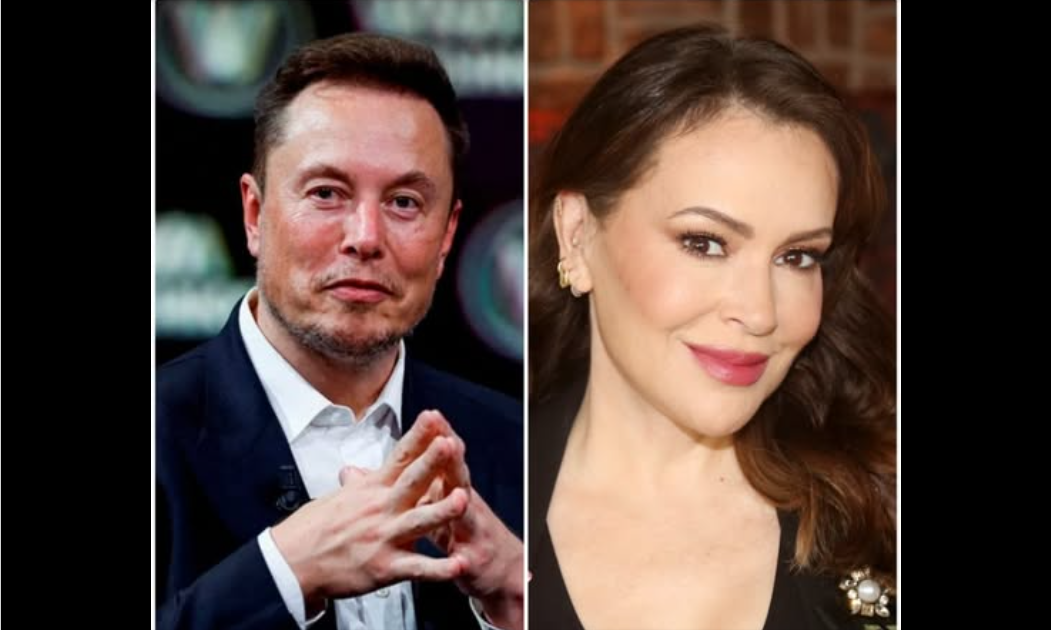
The landscape of Hollywood and Silicon Valley has been set ablaze by one of the most significant legal confrontations of the modern era. Alyssa Milano, a household name known for her era-defining roles in television, has officially initiated a massive $400 million lawsuit against tech titan Elon Musk.
This is not just another celebrity dispute over a social media post or a temporary misunderstanding in the public eye. It is a calculated and deeply personal legal strike that alleges the world’s richest man has used his influence to systematically dismantle Milano’s career.

For decades, Milano has been a fixture of American entertainment, transitioning from a beloved child star to a powerful activist and leading lady. However, she claims that her professional trajectory took a sharp and devastating turn following a series of interactions with Musk and his digital empire.
The core of the lawsuit centers on the allegation that Musk’s behavior—both direct and indirect—has fostered an environment so toxic that it has rendered Milano “unemployable” in certain circles. This is a bold claim that touches on the very nature of digital power.
Milano’s legal team argues that as Musk took the reins of major social platforms, he didn’t just change the code; he changed the culture. They assert that this new culture was specifically weaponized against those who dared to criticize the billionaire’s vision or policies.

As an outspoken activist, Milano has never been one to shy away from controversy, but she maintains that the backlash she faced under Musk’s era was different. She describes it as a coordinated effort to diminish her standing as a public figure.
The financial figures being discussed are staggering, with $400 million reflecting the projected loss of lifetime earnings, endorsements, and business opportunities. Milano claims that major deals began to evaporate as the digital climate surrounding her name grew increasingly hostile.
In the entertainment industry, reputation is the only currency that truly matters, and Milano alleges that Musk bankrupted her reputation. The suit details how specific interactions on social media served as catalysts for broader campaigns of harassment that scared off potential collaborators.
Critics of the lawsuit point toward the complexity of proving a direct link between a billionaire’s tweets and an actress’s casting calls. Yet, Milano’s team is prepared to present data that shows a clear “before and after” snapshot of her professional opportunities.
Elon Musk, known for his defiant stance on legal challenges and his unwavering commitment to his version of free speech, has not remained silent. His defense is expected to lean heavily on the First Amendment and the idea of personal responsibility.
The Musk camp is likely to argue that the decline of any career in Hollywood is subject to a multitude of factors, ranging from market trends to personal choices. They view this lawsuit as an attempt to penalize a man for the opinions of his millions of followers.
However, the legal framework of this case goes beyond just hurt feelings or mean comments; it explores the concept of “tortious interference.” This is a legal term for when one party intentionally damages another’s contractual or business relationships.
Milano believes she has the evidence to show that the interference was not accidental but was a byproduct of the digital architecture Musk championed. She argues that the algorithms were tuned to amplify voices that sought to bring her down professionally.
This case has already sparked a massive debate among legal scholars regarding the responsibilities of platform owners. If a platform owner is also a public figure who engages in the fray, where does the line of liability begin and end?
The social media landscape has evolved into a town square, but Milano’s suit suggests it has become a coliseum where the owner can decide who gets the thumbs down. This power dynamic is what the $400 million figure seeks to challenge at its core.
For Milano, this is clearly about more than just the money; it is about the principle of digital safety for public figures. She has voiced her concerns that if a billionaire can target a celebrity with her resources, no one is safe.
On the other side, Musk’s supporters see this as a classic case of a celebrity struggling with relevance and looking for a deep-pocketed scapegoat. They argue that the public’s reaction to Milano’s political stances is a result of her own actions, not Musk’s.
The tension between these two narratives is what makes this the trial of the century for the digital age. It pits the old guard of Hollywood activism against the new guard of Silicon Valley disruption in a winner-take-all battle.